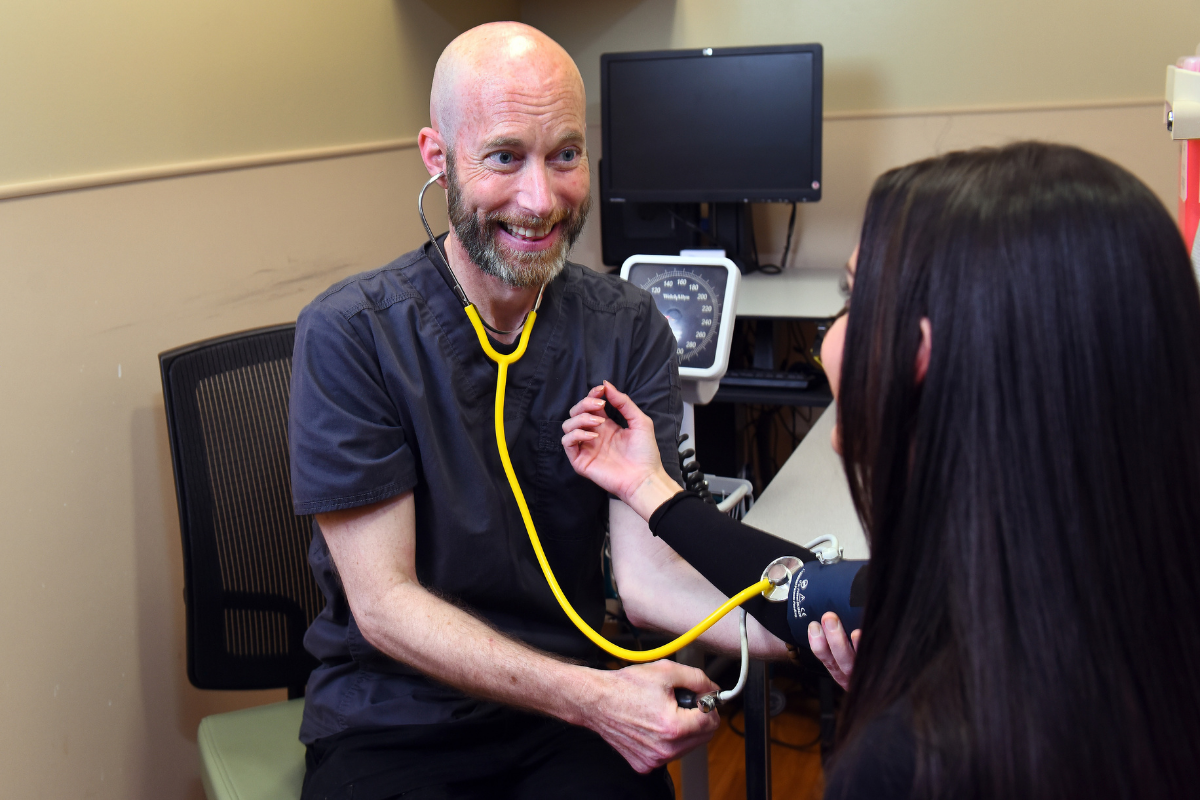
What if you could get primary care, behavioral health support, labs and prescriptions in one place, without starting over each visit? At WellPower, integrated primary care is designed for people navigating trauma, chronic conditions and everyday barriers like transportation or housing. We sat down with Denise Hosier, C-ANP, clinical director of integrated care and nursing services, to find out how it works and why it matters.
1. What does primary care look like at WellPower?
Denise Hosier (DH): Primary care at WellPower is pretty straightforward: it’s all in-house at our main outpatient site, and we’ve got a lab and a pharmacy right here too. So people can get a lot done in one place – somewhere they already know, and already feel comfortable coming to for their case manager, provider or therapist. We really try to make the clinic feel welcoming, and we want people to feel respected the minute they walk in. Because we’re integrated, our psych providers can see someone’s primary care meds in their health record and we can see what they’re on from the psychiatry side, which makes it way easier to coordinate care. And that’s really the point – we’re taking care of the whole person, which is really important because mental health affects physical health and vice versa. Over the last 15 years, we’ve also built up our own specialty referral network, and that’s a big part of why the program works as well as it does today.
2. WellPower is a mental health organization – why do we offer primary care?
DH: A big reason is our focus on the social determinants of health – the other aspects of people’s lives that all contribute to their overall well-being, such as stable housing, food, transportation, safety, insurance, being able to take time off, even just having a phone that works. Our folks can be complex, and many face a lot of barriers in these areas. When those pieces aren’t in place, it’s really hard to keep up with a traditional primary care office, and then people tend to end up relying on the ER or urgent care. Having primary care inside a mental health center lets us wrap services around people, coordinate closely with their treatment team, slow down, explain things and help problem-solve the real-life stuff that gets in the way so they can actually get consistent care and stay healthier.
3. What does primary care at WellPower look like day to day?
DH: Day to day, it usually starts with someone checking in and getting greeted by one of our nurses. We’ll take vitals, ask what brought them in and what they want help with, and then they’ll see a provider who focuses on what they came for – but also on anything else we notice that needs attention. That might mean listening to heart and lungs, talking about smoking and whether we should run a few tests, looking at chronic conditions and making sure we’re not missing prevention stuff like cancer screenings, family history risks or other comorbidities, including substance use. If they need labs we can do blood work, and having our pharmacy right here makes it easier to get medications started without a bunch of extra steps. We also work closely with case managers so we can connect people to other care and resources when they need it. And we’re really intentional about being trauma-informed, so we don’t force anyone into screenings like Pap smears or colonoscopies if they’re not ready. We talk it through, explain the “why” and move at their pace. A lot of our folks have ended up getting care through the ER or urgent care for years, so we’re trying to change that by addressing issues earlier and helping prevent things from turning into emergencies.
4. What are the most common health concerns you address in primary care, and how do they intersect with mental health?
DH: The most common things we’re treating are hypertension, diabetes, high cholesterol and chronic pain – and a lot of the time these have been going on for a while. Many of our folks have been overlooked for so long that they’re behind on preventive care, so if someone tells me they haven’t seen a provider in 10 years, we’re going to focus on catching up and preventing problems for as long as we can. And the medical side really does intersect with mental health: when diabetes is uncontrolled, people can have trouble with thinking and focus, and thyroid issues can look a lot like anxiety or depression – if you have hyperthyroidism [overactive thyroid] you can feel really anxious, and if you have hypothyroidism [underactive thyroid] it can feel like chronic depression, low energy and sleep issues. When people are finally able to get their medical needs addressed, they’re often in a much better place to engage in their mental health care, too.
5. How does WellPower’s approach to primary care differ from traditional clinics?
DH: We’re honestly a lot more flexible than a traditional clinic, because we know our population. If someone no-shows or shows up late because their mental health symptoms got in the way, we don’t just write them off – we do our best to still get them in and meet them where they are. We’re trauma-informed, we take more time to answer questions and we coordinate really closely with the treatment team, because we know it can be hard to manage medical care on top of everything else. And one of the biggest differences is how connected we are: I can literally walk down the hall and talk with their psych provider, so we can problem-solve together and keep the care consistent.
6. What’s the most moving or transformative case you can remember?
DH: There have been so many over the years. Here are just a few from our whole team (shoutout to our entire primary care staff: Jessica Viton, DNP, FNP, PMHNP; Sarika Steinhaus, FNP; Renee Kercher, LPN; Amanda Kroeker, Project Coordinator for Adult Integrated Care):
- A person served in our residential program was experiencing symptoms of low potassium, and our primary team coordinated with residential staff to get the person to the emergency department. Fortunately, we caught it in time and she received treatment at hospital for urgently low potassium.
- There was someone whose mania was getting worse unexpectedly. We identified that the course of prednisone she had been prescribed was causing this, so we were able to wrap up that course and get her off the prednisone. She felt better afterward and was so proud that she was able to recognize her symptoms and take action.
- We diagnosed someone with hyperparathyroidism, which can cause neuropsychiatric symptoms, and they are now managing this physical health condition with a specialist, improving their mental health as well.
- We helped someone who had acute suicidal ideation, including a specific plan to end their life, to connect with emergency psychiatric support at our Behavioral Health Solutions Center, saving their life.
- There was someone who was diagnosed with diabetes out of state, and originally did not believe it. After working with us for a year, they finally came to believe their diagnosis, and their A1c decreased from 10.4 to 7.6.
7. What barriers do patients face when accessing primary care at a mental health center, and how does WellPower help overcome them?
DH: A lot of the barriers are really about fear of the unknown. Some people are worried about what a test is going to find, especially when you’re talking about things like cancer screening. Some folks have had past experiences where they weren’t treated equitably in a medical setting, so they’re understandably hesitant. The testing itself can feel intimidating too: “What are they going to do to me?” and even the prep for certain tests can be overwhelming. Another big barrier is money – people worry they’re going to get a surprise bill. So we slow it down, we explain exactly what to expect, we answer a lot of questions and we do our best to make it feel as safe and manageable as possible. We also reassure people about costs: for example, the lab we use won’t charge them, and our pharmacy helps reduce barriers too because people can typically get the best pricing with us and get support if there’s an issue.
8. What if WellPower’s primary care program didn’t exist?
DH: If our primary care program didn’t exist, I honestly think a lot of people would fall through the cracks. In a lot of traditional clinics, if you no-show two or three times, you’re discharged – and with the symptoms our folks are managing, that happens, and then people end up relying on urgent care or the ER. Here, we can meet people where they are, and if someone comes in worried about a symptom that could be mental health, we can also check in on the medical side – things like blood pressure, diabetes management and what might actually be going on physically. We expect comorbidities and complicated medication lists, so having coordinated care in one place really helps me feel confident people are getting the quality and continuity of care they deserve.
9. How do people get started with primary care at WellPower?
DH: It’s pretty simple to get started. We have a referral in our EHR [electronic health record], and any provider or staff member can put one in. From there, we check insurance and get the person scheduled, and we also notify their team so everyone stays in the loop. A lot of the time, it’s just someone on staff recognizing, “Hey, this person would really benefit from having primary care,” and getting that referral in so we can connect them.
10. What advice would you give to someone considering starting primary care services at WellPower?
DH: My biggest advice is: don’t overthink it – just come in. We’re trauma-informed, we’ll meet you where you are and we’ll take the time to really listen to what you need. We also work closely with your treatment team, so you’re not trying to juggle everything on your own. It’s kind of a one-stop shop, and I’m really proud of the care we’re able to provide here.
11. What are you most excited about coming up in primary care at WellPower?
DH: I’m most excited about being able to get as many people in as we can and just knowing they’re actually getting consistent primary care. We really just want folks to get good care, and if we can keep growing the program, that would be amazing. It would mean we can reach more people, build more capacity and hopefully bring on more staff so we can keep up with the need.
Join Our Email List
Sign up to receive our monthly newsletter, invitations to events and opportunities to support our mission.